

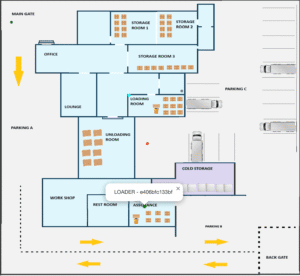
Warehouse Monitoring System for Small Business
A warehouse monitoring system for a small operation isn’t about tracking where every pallet is — that’s a job for a full WMS with location tracking. It’s about knowing the condition of your space and equipment without walking the floor to check: is the cold room holding temperature, is a conveyor motor running hotter than it should, is humidity creeping up somewhere it shouldn’t. For a small team, that’s the gap between catching a problem before it costs you stock and finding out after.
Why Warehouse Monitoring Means Condition, Not Just Location
It’s easy to lump “warehouse monitoring” in with asset tracking, but they solve different problems. Location tracking tells you where something is. Condition monitoring tells you whether it’s still in the state it needs to be in — the right temperature, the right humidity, still running rather than overheating. A small warehouse handling perishables, pharma, or equipment-dependent operations often needs the second more urgently than the first, and it’s usually cheaper to deploy.
What a Warehouse Monitoring System Actually Watches
Temperature and Humidity
Sensors placed in cold storage, pharma storage, or any humidity-sensitive area log readings continuously and alert your team the moment a reading drifts outside a set range — before spoilage happens, not after a claims dispute.
Equipment Condition
Vibration and runtime sensors on motors, conveyors, and refrigeration units flag abnormal patterns early — a motor running hot or a compressor cycling more than usual — so a breakdown becomes a scheduled fix instead of an unplanned stoppage. This pairs directly with a CMMS: the sensor flags the anomaly, the CMMS turns it into a work order.
Zone-Level Environmental Alerts
Rather than tracking individual items, zone sensors cover an area — a storage bay, a loading dock, a cold room — so one sensor gives you condition data for everything in that space rather than needing a tag on every pallet.
Built for Small Business Deployment
- DIY deployment: sensors connect wirelessly and can be mounted by your own team, no integrator project required.
- No cabling: battery-powered sensors avoid the electrical work a wired system would need.
- Local support and spares: replacement sensors are serviceable locally, not dependent on an import cycle.
- Low-bandwidth friendly: the dashboard runs over a standard internet connection.
- Starts small: begin with sensors on your highest-risk zone — the cold room, the critical motor — and expand as needed, without a re-platform.
How This Fits With the Rest of Your Warehouse Systems
Condition monitoring works alongside, not instead of, a full warehouse management system. If you’re evaluating a complete WMS, our smart warehouse management system covers full receiving-to-dispatch functionality. For a structured comparison of WMS options generally, start with our guide to choosing the best WMS software for small business.
According to Gartner Peer Insights, real-time visibility into inventory and labour is a core capability separating a modern warehouse operation from one relying on periodic manual checks — the same principle applies to equipment and environmental condition, not just stock location.
Frequently Asked Questions
Is this the same as RTLS asset tracking?
No. RTLS tracks the live location of pallets, equipment, or people. A warehouse monitoring system tracks the condition of a space or piece of equipment — temperature, humidity, vibration — rather than where something is. Many small warehouses need condition monitoring first, since spoilage and equipment failure are often the costlier risk.
Can a small warehouse deploy this without an IT team?
Yes. Sensors are battery-powered and mount without cabling, and the dashboard is accessible from any standard internet connection. Most small teams can have a proof of concept running within a day.
Does this replace a CMMS?
No, it feeds one. The sensor data flags an issue; your CMMS turns that flag into a scheduled work order, so the two work together rather than duplicating each other.
Request a free demo and see how warehouse condition monitoring fits your operation.