
RTLS Patient Tracking Software for Improving Experience and Safety
Custom Patient Tracking Software, Not a Fixed Box
Software Associates India builds patient tracking software as a custom services engagement, not a one-size-fits-all product — every hospital’s floor plan, existing HIS/EMR, and maintenance workflow is different, and our patient tracking software deployment is scoped around what you already have rather than a generic template. The same real-time location data this patient tracking software collects also integrates directly with your CMMS for maintenance triggers, demand forecasting for supply and capital planning, and a digital twin of the facility if you want a live visual layer on top.
Patient Tracking System in Hospital
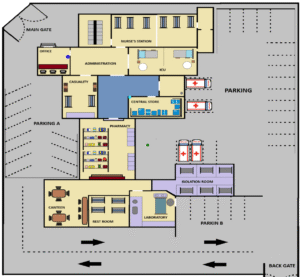
The easy-to-maintain patient tracking system in hospital provides a real-time dashboard with asset inventory on each floor of the hospital. Bluetooth Low Energy (BLE) beacons, asset tracking tags, and wearable devices can be assigned to each object that needs to be tracked. For example, an elderly patient can be assigned a wristband which helps the operations team to understand the location, wait time and movement within the hospital premises. High-value equipment, such as microscopes, etc, can be tagged to prevent unauthorised usage and theft using our patient tracking software.
Patient Location Visibility and Wait Time Reporting
Core Focus: Patient Journey Management / Navigation
Location data provides a vital basis for streamlining a patient’s journey throughout the hospital. By accurately tracking individuals (e.g., using secure badges or identifiers), facilities gain clear insights into operational speed:
- Wait Time Metrics: Systems automatically compute and display the duration a patient waits for critical services, such as a doctor’s consultation, diagnostic imaging, or laboratory procedures. This information empowers management to pinpoint and resolve throughput bottlenecks, directly enhancing the Overall Patient Experience and driving up satisfaction levels.
- Service Efficiency: Ensuring patients transition smoothly through high-pressure areas like the Emergency Department (ED) or surgical suites, thereby reducing delays and improving the total Service Delivery Time.
Locating Essential Paramedical Personnel
Core Focus: Staff Coordination / Critical Resource Deployment
Precise, real-time knowledge of where crucial support staff—such as respiratory therapists, laboratory technicians, or radiology specialists—are located is key to swift emergency response.
- Crisis Intervention: During a medical emergency, Personnel Tracking technology enables the instant identification and notification of the nearest, most qualified professional, drastically cutting down clinical response times and supporting better Patient Outcomes.
- Workload Allocation: Facilitating the intelligent assignment of tasks by matching staff availability and proximity to current clinical requirements, which leads to improved departmental efficiency.
Monitoring Nurse Activity Within Clinical Units
Core Focus: Clinical Process Analysis / Staffing Efficiency
Analysing the movement of the nursing workforce provides objective data to refine care delivery methods, moving beyond simple individual oversight. This analysis is fundamental to maximising Nursing Team Productivity using a patient tracking system.
- Minimising Non-Care Time: Data shows how much time nurses spend looking for colleagues or mobile assets versus time dedicated to Direct Patient Interaction.
- Fair Staff Distribution: Identifying areas of high activity or congestion helps ensure balanced Staff-to-Patient Ratios, contributing to a reduction in staff fatigue and boosting Workforce Retention.
Tracking Surgical Procedures and Equipment Status
Core Focus: Operating Room (OR) Throughput / Specialised Asset Availability
This capability links personnel, processes, and specialised hardware tracking to maximise the operational capacity of expensive surgical theatres.
- Operating Suite Changeover: Systems automatically record the timeline from patient exit to the start of room cleaning and finally, to certification of readiness for the next procedure. This data is critical for increasing Surgical Capacity.
- Instrument Logistics: Linking location data with the Sterile Processing Department (SPD) inventory guarantees that sterile, customised Surgical Trays are staged and ready at the OR exactly when required, eliminating expensive procedural setbacks.
Managing Mobile Equipment (e.g., Carts, Monitors)
Core Focus: Medical Asset Oversight / Device Optimisation
Misplaced or ‘hidden’ equipment wastes clinical time and forces unnecessary spending on replacements. Hospital Asset Management addresses this challenge.
- Immediate Location: Clinicians can quickly find the closest available Infusion Pump or Patient Transport Device, removing the delays associated with manual searching.
- Utilisation Metrics: Providing objective data on how often assets are used feeds directly into demand forecasting for capital planning, ensuring optimal inventory levels and lowering reliance on high-cost emergency equipment leasing.
Locating Facility and Biomedical Technicians
Core Focus: Engineering Workflow / Service Response
Rapidly deploying the appropriate technical expert is essential for safety and operational continuity.
- Fast Maintenance Dispatch: When key machinery (like an MRI scanner or a crucial HVAC unit) signals a fault, the system immediately directs the work order to the nearest qualified Biomedical or Facility Technician through your CMMS, minimising System Downtime and maintaining continuous service with the help of our patient tracking software.
Verifying the Activity of Housekeeping and Maintenance Teams
Core Focus: Compliance Auditing / Environmental Sterilisation
Using location data integrated with maintenance logs provides a verifiable record for meeting health and safety regulations.
- Hygiene Assurance: Confirms that high-risk zones, such as surgical recovery bays or isolation rooms, have been thoroughly sanitised before the next occupant, reinforcing Infection Prevention strategies.
- Protocol Adherence: Allows for objective, automated monitoring of staff adherence to critical protocols, such as using specific entry/exit points or mandatory hand hygiene stations.
Monitoring Temperature-Sensitive Medical Supplies
Core Focus: Pharmaceutical Integrity / Regulatory Safety
Protecting the effectiveness and safety of temperature-critical items, including Vaccines, Blood Products, and specialised medications, is an absolute requirement.
- Continuous Temperature Tracking: IoT sensors deliver constant, automated monitoring of storage units. If temperatures deviate outside of mandated limits (2°C to 8°C), instant alerts are sent, enabling immediate action to prevent the irreversible loss of Pharmaceutical Stock.
- Compliance Documentation: Automated logging creates a tamper-proof history of temperature records for mandated regulatory reporting and audit purposes.
Early Identification of Infrastructure Problems (e.g., Motors, A/C Units)
Core Focus: Infrastructure Reliability / Proactive Facilities Care
This represents a change from fixing equipment after it fails to using data to predict potential issues.
- System Health: Deploying sensors (monitoring variables like vibration signatures, heat output, or energy consumption) on vital hospital infrastructure—including HVAC Systems and utility pumps—to spot subtle operational changes.
- Failure Avoidance: Predicting when equipment might fail weeks ahead of time feeds into your preventive maintenance schedule, avoiding sudden malfunctions, ensuring a stable Healing Environment, and drastically cutting emergency repair expenditures.
How This Gets Deployed as a Services Engagement
Every hospital’s patient tracking software rollout is scoped individually — the effective RTLS solution for a 200-bed general hospital looks different from a speciality eye clinic. A typical engagement includes:
- Fully wireless deployment for patient tracking in under 30 days
- 50 RTLS patient tracking tags with 2-year battery life
- 30 anchors giving coverage for up to 6,000 square metres in the outpatient department
- Ripples IPS dashboard software with floor plan, business rules, alerts and notifications
- 1-year software license for 50 patient tracking tags
- Gateway device with WiFi and 4G connectivity
- Custom integration work connecting the patient tracking software feed into your existing CMMS, demand forecasting, or digital twin systems, where you already have one running
Call for pricing — every deployment is quoted against your facility’s actual layout and tag count, not a fixed package.
Call us to know more about our patient tracking software, the benefits of deploying a patient tracking system in hospital, and how it integrates with CMMS-driven preventive maintenance to enhance patient experience and safety.